
A lot of business owners start a podcast by choosing cameras, microphones, a show name, or a clever intro. Those choices feel productive because they are visible. They are also downstream.
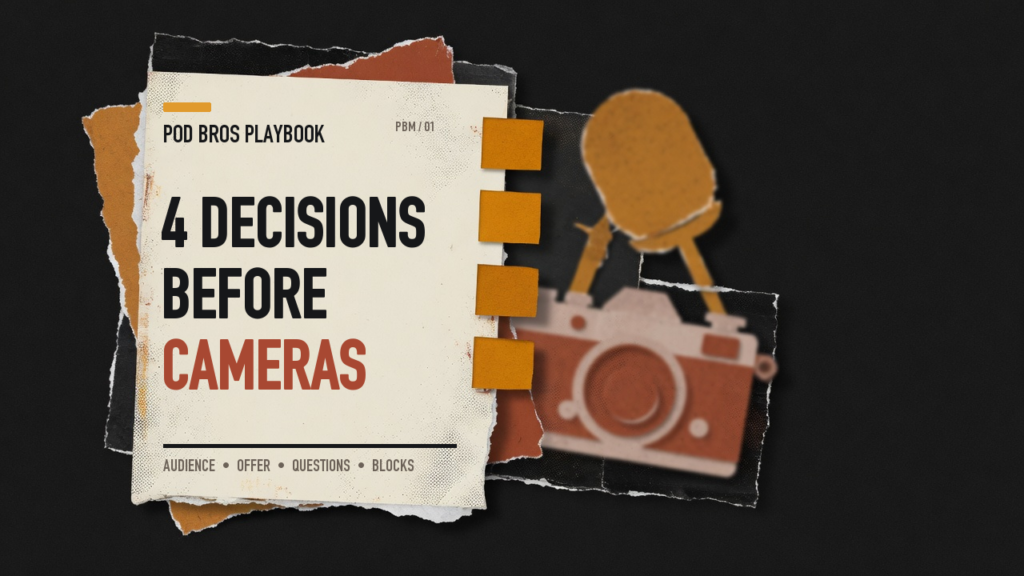
Before cameras turn on, a business podcast needs four decisions: who the show is for, what business offer it supports, which recurring questions it will answer, and how those questions will be grouped into recording blocks.
That is the planning method we use at Pod Bros Media. It keeps recording days focused, gives each episode a job, and makes publishing easier because the strategy is settled before production begins.
Gear is rarely the first bottleneck
A clean studio matters. Good audio matters. Lighting, framing, editing, and distribution all matter. But production quality cannot rescue an unclear premise.
If the audience is “business owners,” the topics usually stay broad. If the goal is “build awareness,” nobody knows what a useful episode should accomplish. If the show depends on inventing a brilliant topic every week, consistency becomes a recurring emergency.
The result is a technically polished show that feels disconnected from the actual business. The host spends too much time preparing, episodes wander, and the content team has to reverse-engineer a strategy from whatever happened in the room.
The fix is not a more expensive camera. It is a one-page decision brief.
Decision 1: Name the audience precisely
“Entrepreneurs” is not an audience. Neither is “professionals.” A useful audience definition describes a person with a recognizable situation.
For example:
- Arizona benefits brokers preparing clients for renewal conversations
- Law-firm partners trying to turn referral trust into direct demand
- Fractional marketing leaders who need clients to understand a complex buying decision
- Founder-led service businesses whose best sales material is still trapped in calls
The point is not to make the show artificially small. The point is to make each episode useful to someone specific. A precise audience gives the host a filter: would this person care, understand why it matters, and know what to do next?
If the answer is vague, the topic is not ready.
Decision 2: Connect the show to the offer
A branded podcast should help the right buyer make progress toward a decision. That does not mean every episode becomes a pitch. It means the show and the business are pointed in the same direction.
Write down the offer the podcast supports. Then ask what a buyer needs to understand, believe, compare, or prepare before that offer makes sense.
A podcast studio might support monthly production. The show can explain content planning, authority building, recording preparation, distribution, and the difference between owning a media system and renting attention one post at a time.
A CPA firm might support year-round advisory work. The show can clarify the recurring decisions clients make outside tax season. A law firm might support a specific practice area. The show can answer the questions clients hesitate to ask in a first meeting.
This connection gives the content commercial relevance without turning it into an ad.
Decision 3: Build from recurring questions
The strongest starting topics are usually not trends. They are the questions the team already answers in sales calls, onboarding, client meetings, and follow-up emails.
Make a list of questions that show up repeatedly:
- What does a good client need to understand before hiring us?
- Where do prospects compare the wrong things?
- Which concern takes five minutes to explain live but never fits in a social caption?
- What mistake creates the most avoidable delay, cost, or confusion?
- What changed in our point of view after doing this work repeatedly?
Each question can become an episode. A group of related questions can become a short series. Because the source is real buyer friction, the content stays useful after the week it is published.
It also creates first-party material. The host is not summarizing the same article everyone else read. The host is documenting judgment earned inside the business.
Decision 4: Turn topics into recording blocks
Once the audience, offer, and question bank are clear, group related topics into a recording block.
A recording block is a planned set of conversations captured in one session. The episodes should share enough context that the host can stay in the same mental lane, but each one still needs a distinct promise.
A simple block might include:
- The buyer mistake that creates the problem
- The framework used to evaluate the decision
- A real trade-off or objection
- The next step a buyer can take before calling anyone
This is more efficient than arriving with one loose topic and hoping the conversation produces a month of content. The producer can prepare transitions, supporting visuals, titles, and distribution assets around a known structure.
The one-page brief
Before recording, the host and producer should be able to look at one page and see:
- Audience: the person and situation the show serves
- Offer: the business outcome the show supports
- Question bank: the recurring decisions and objections worth answering
- Recording block: the specific episodes planned for the session
- Point of view: what the host believes that makes the answer worth hearing
- Next step: what the listener can do after the episode
If those fields are clear, production becomes much calmer. The host does not need to memorize a script. The producer can direct the conversation instead of rescuing it. Editing has a clear destination. Titles and descriptions come from the actual promise of the episode.
What changes in the room
Preparation should not make the conversation stiff. It should remove the uncertainty that makes people sound stiff.
When the strategy is settled, the host can focus on explaining the idea naturally. The producer can ask for a clearer example, slow down a dense section, or pull the conversation back to the buyer. The recording feels less like performing and more like doing the work the expert already knows how to do.
That is why our production process starts with strategy and our monthly podcast production plans begin by mapping the audience, offer, recurring questions, and recording blocks.
Start with the decisions, then choose the cameras
A business podcast does not need a giant strategy document. It needs a few decisions that keep every later choice honest.
Know who the show is for. Know which offer it supports. Collect the questions buyers already ask. Group those questions into recording blocks. Then let the studio, producer, and distribution system do their jobs.
If you want help turning your expertise into a show that is planned before recording day, book a brief discovery call with Pod Bros Media. We can map the audience, format, topics, and production path with you.